
POOR HVAC DESIGN & ITS COSTS
The Cost of Poor HVAC Design: Oversizing, Undersizing, and Duct Problems
Review how oversizing, undersizing, and duct system problems can affect residential HVAC performance and the costs associated with correcting them.
How Oversizing Affects System Performance
An oversized heating or cooling system has more capacity than the building requires under the applicable design conditions and equipment selection criteria. Oversizing often occurs when equipment is selected using broad square-footage rules, assumptions about existing equipment, or additional capacity added without supporting calculations.
Excessive cooling capacity can cause some systems, especially single-stage equipment, to operate in shorter cycles. Short run times may limit moisture removal and contribute to temperature swings. The actual effect depends on equipment controls, airflow, operating conditions, and the amount of oversizing.
Oversizing can also increase initial equipment costs when a larger unit is purchased unnecessarily. Depending on the equipment and installation, larger capacity may require different electrical provisions, duct arrangements, or other supporting components.
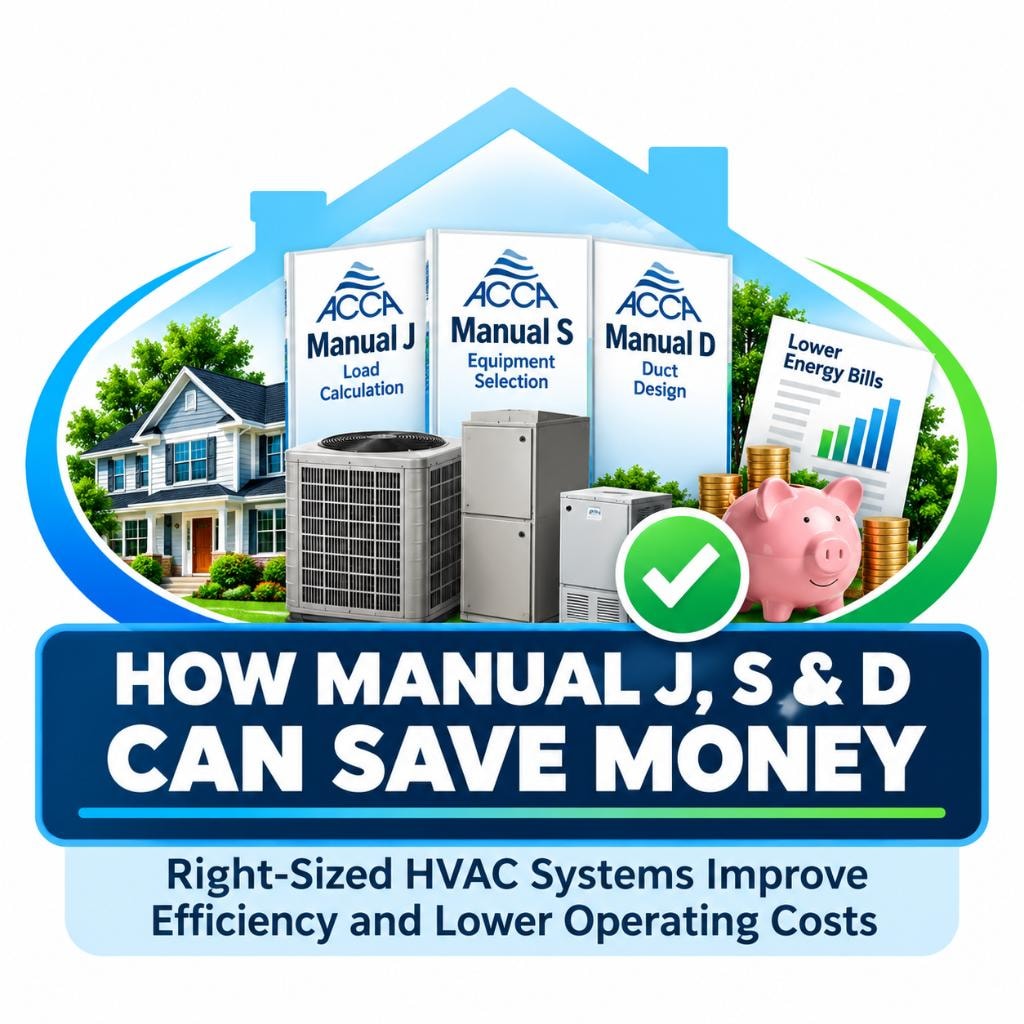
ACCA Manual J establishes the calculated loads, while Manual S evaluates suitable equipment using manufacturer performance information. These procedures help identify an appropriate capacity range rather than assuming that larger equipment is always better.
How Undersizing Affects System Performance
Undersizing occurs when the selected equipment cannot provide sufficient heating or cooling capacity for the calculated design conditions. The result may be difficulty maintaining the intended indoor temperature during periods of high heating or cooling demand.
An undersized air conditioner may operate for extended periods without reaching the thermostat setting during peak cooling conditions. A heating system with inadequate available capacity may similarly struggle during cold weather. Extended operation alone does not prove undersizing, because appropriately sized equipment can run for long periods under demanding conditions.
For heat pumps, heating capacity must be evaluated at relevant outdoor temperatures. Supplemental heating requirements, defrost operation, and manufacturer performance data may affect the overall equipment selection and expected operation.
Correcting inadequate capacity after installation can be expensive if the solution requires replacing equipment or modifying electrical and distribution systems. Accurate load calculations and equipment selection help reduce the likelihood of these problems before installation.
How Duct Problems Affect Delivered Performance
A ducted HVAC system must move the required airflow through supply and return pathways. Ducts that are improperly sized or configured can create excessive resistance, reduce airflow, and contribute to uneven temperatures between rooms.
Insufficient airflow across equipment may also affect operating performance. Actual consequences depend on the equipment type and its operating limits, but distribution problems can prevent the system from delivering the intended heating or cooling to occupied spaces.
Duct leakage and heat transfer through ductwork located outside conditioned space can create additional losses. Sealing duct connections and insulating ducts where required are installation measures that complement, but are not substitutes for, proper Manual D design.
Manual D uses airflow requirements, available static pressure, and duct resistance to establish appropriate duct dimensions and layout. A design must still be installed correctly and verified in the field to achieve the intended performance.
The Cost of Corrections After Installation
HVAC design problems are generally easier to address before equipment and ductwork are installed. Once construction is complete, correcting an improperly sized system or inadequate duct layout may require additional labor, materials, and access to concealed components.
Possible corrections include replacing equipment, modifying supply or return ducts, adding properly designed airflow pathways, or repairing leakage and insulation deficiencies. The appropriate remedy depends on a diagnosis of the actual problem, not an assumption that every comfort complaint requires larger equipment.
Costs can extend beyond the immediate repair. Homeowners may experience ongoing comfort complaints, inefficient operation under certain conditions, or unnecessary equipment replacement when the original design and installation problems remain unresolved.
Coordinated Manual J, Manual S, and Manual D procedures help identify important sizing and distribution requirements before installation. They cannot eliminate every future expense, but they provide a documented technical basis that can reduce the risk of avoidable design-related corrections.
Technical References

About the Author, Tracy Savoy
Tracy Savoy, owner of Savoy Engineering Group, has worked with residential HVAC design since 2005. Her ACCA training and Wrightsoft experience inform her practical guidance on how oversizing, undersizing, and duct design problems can lead to unnecessary costs and expensive corrections after installation.
View Tracy's Training & Experience