
Manual S Equipment Selection
Manual S Equipment Selection: What It Is and Why It Matters
Manual S is the ACCA standard that governs how residential HVAC equipment is selected. It uses the heating and cooling loads from Manual J together with manufacturer performance data to evaluate equipment and apply the appropriate sizing requirements.
What Is Manual S Equipment Selection?
ACCA Manual S establishes the procedures for selecting residential heating and cooling equipment based on the loads calculated using Manual J. The process evaluates actual equipment performance under the home's design conditions rather than relying solely on nominal equipment capacity or tonnage.
Manufacturer performance data is used to verify that the selected equipment meets the applicable heating and cooling loads, including sensible and latent cooling requirements. Manual S also establishes sizing limitations intended to avoid excessive equipment oversizing.
Why Equipment Selection Requires a Formal Standard
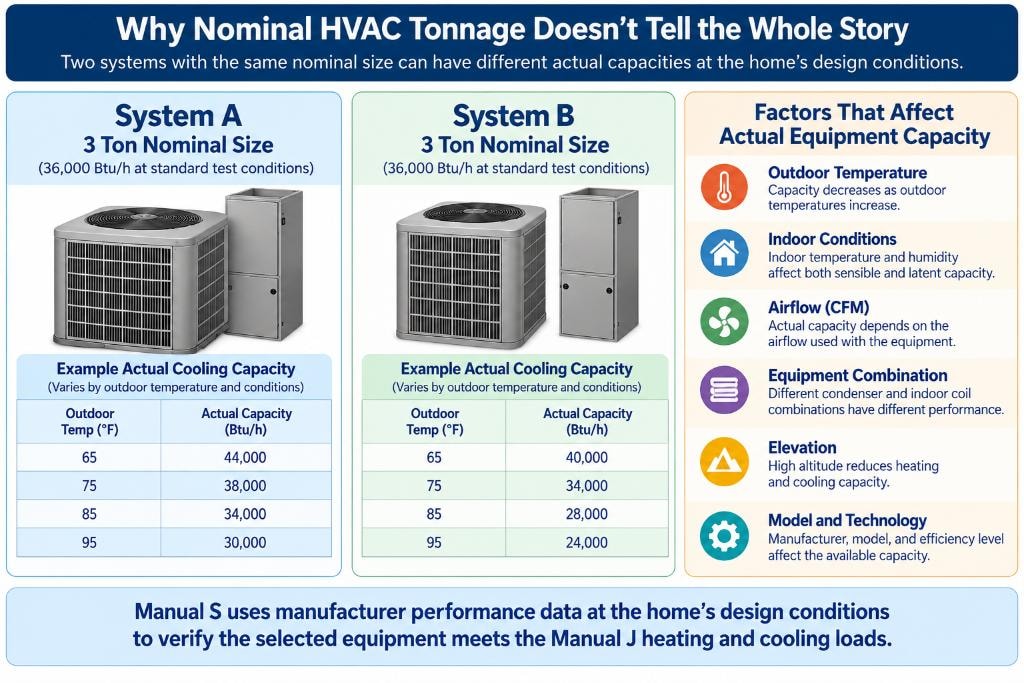
Two HVAC systems with the same nominal tonnage may deliver different heating and cooling capacities under actual operating conditions. Outdoor temperature, indoor conditions, airflow, and equipment configuration can all affect performance.
Manual S provides a consistent method for comparing manufacturer performance data with the Manual J loads. This helps prevent equipment from being selected solely by square footage, nominal tonnage, or rules of thumb.
How Manual S Verifies Equipment Performance
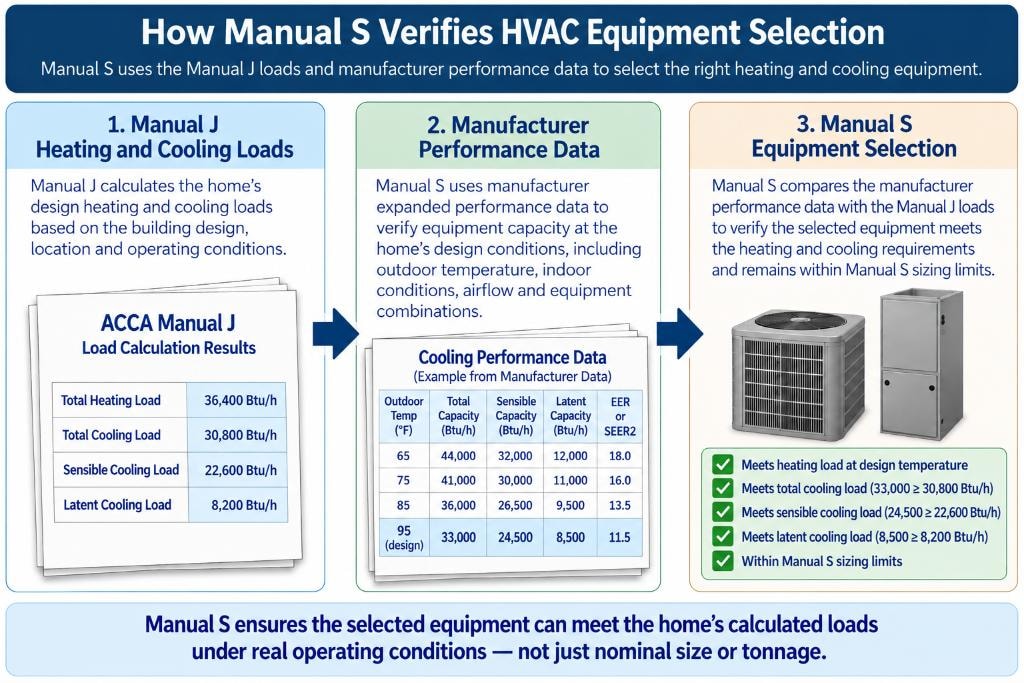
Manual S equipment selection involves reviewing manufacturer performance data for the proposed heating and cooling system. These data show how equipment capacity changes with outdoor temperature, indoor conditions, airflow, and equipment combinations.
For cooling equipment, both total and sensible cooling capacities must be evaluated against the Manual J loads. Latent capacity, which removes moisture from indoor air, is also important. For heat pumps, heating performance must be checked at the applicable winter design temperature, including whether supplemental heat is needed.
The goal is to select equipment that satisfies the calculated loads while remaining within the applicable Manual S sizing limits.
How Manual S Connects to Manual D
Manual J determines the home's heating and cooling loads. Manual S uses those loads to select appropriate equipment based on its verified performance. Manual D then uses the equipment's airflow requirements and room-by-room loads to design the residential duct system.
These three standards work together, but each serves a different purpose. A properly calculated load does not automatically mean the selected equipment has adequate capacity, and correctly selected equipment still requires an appropriately designed air distribution system.
Technical References

About the Author, Tracy Savoy
Tracy Savoy, owner of Savoy Engineering Group, has worked in residential HVAC design since 2005. Drawing on her ACCA Manual J, S, and D training, she explains how equipment selection connects calculated heating and cooling loads with manufacturer performance data.
View Tracy's Training & Experience